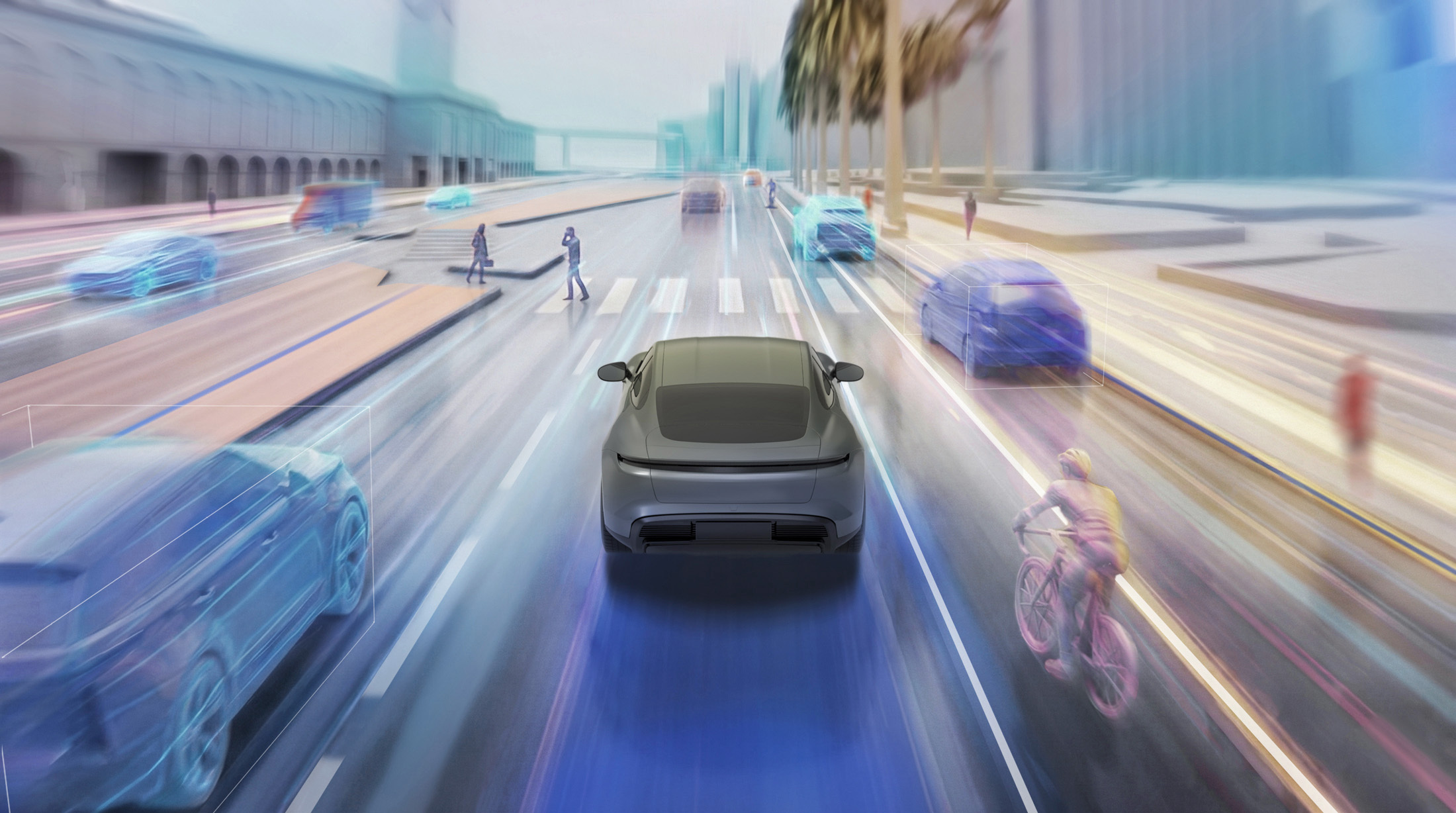
Generates highly realistic driving sequences completely from scratch, producing entirely new datasets without requiring any baseline real-world video inputs.

Produces diverse driving scenes, encompassing various geographies, vehicle types, pedestrians, cyclists, intersections, turns, weather conditions, and illuminations.

Delivers five times higher pixel density than traditional state-of-the-art benchmarks by producing stunningly detailed 1920x1080 resolution video per camera.

Guarantees self-consistency across a full 6-camera suite simultaneously, rendering a completely synchronized 12-megapixel canvas per timestep.

Highly flexible infrastructure allows engineering teams to optimize compute—whether generating a 3-camera setup for higher frame rates (30 fps) or a 6-camera configuration at 5 fps for full spatial context.

Functions as a virtual sensor by intentionally replicating physical anomalies—such as lens flares, native sensor banding, and exposure blinding—for robust perception training.

Efficiently simulates a wide variety of edge cases and critical scenarios that would be rare, dangerous, or costly to capture with real-world driving fleets.

Serves as a universal generative AI backbone, scaling seamlessly beyond automotive high-end ADAS to power robotics and off-road autonomy.
Explore Helm.ai’s AI software, foundation models, and AI-based development and validation tools.